


Inside the Better Stride V2 Technology Platform
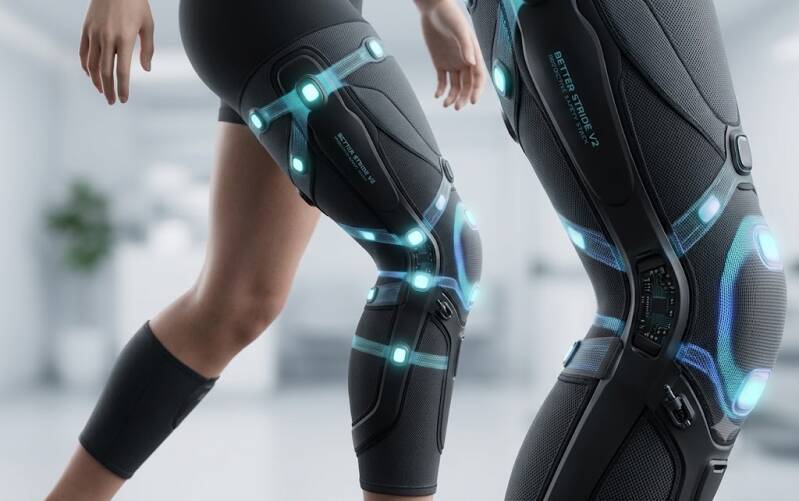
Better Stride V2: The Shift from Reactive Support to Predictive Intelligence.
We have moved beyond the limitations of passive, legacy bracing. Better Stride V2 is not just a support device—it is a software-defined, closed-loop mobility platform that functions as a "second nervous system. By fusing real-time biomechanical analysis with a multi-tier AI intelligence pipeline, we deliver proactive stability that adapts to the environment and the individual in milliseconds."
-
Dynamic AWD Stability: Real-time, intelligent power delivery that corrects gait imbalances before they become falls.
-
Adaptive Bio-Intelligence: Learns your specific biomechanical signature, getting smarter and more intuitive with every step.
-
The Fail-Safe Foundation: Integrated, multi-tier mechanical emergency protocols that guarantee your safety, regardless of system state.
This is the future of human mobility: intelligence that powers your movement and restores your autonomy.
Core Technology Pillars
Multimodal Sensor Grid
Better Stride V2 captures a complete picture of human movement using a distributed sensor network that includes:
-
360° Multimodal Biomechanical Grid: A wrap-around array utilizing over 10 distinct sensor modalities—including high-frequency IMUs, micro vibration sensors, and cross-limb synchronization modules—sampling physical movement at 1000 Hz.
-
Advanced Neuromuscular Sensing: Integrated 8-channel surface electromyography (sEMG) tracking muscle activation dynamics at a massive 2000 Hz to map intent, fatigue, and muscle co-contraction.
-
Environmental Terrain Predictive Lookahead: Solid-state LiDAR providing a 4-meter forward terrain scanning matrix coupled with barometric MEMS sensors for instantaneous stair, ramp, and incline detection.
This provides high‑resolution insight into gait, balance, load, and micro‑instability.
2. Signal Conditioning & Feature Extraction
Raw sensor data is processed in real time to remove noise, identify patterns, and extract meaningful features such as:
-
gait phase
-
stride symmetry
-
load distribution
-
micro‑instability signatures
-
fatigue indicators
-
hesitation markers
This creates a clean, structured data stream for the AI engine.
3. Predictive AI Modeling
Better Stride V2 forecasts instability 200–500 ms before it occurs using:
-
gait prediction models
-
micro‑instability classifiers
-
deviation forecasting
-
real‑time biomechanical inference
This predictive capability is what separates Better Stride V2 from reactive mobility devices.
4. Emotional‑AI Layer
Movement is emotional — stress, hesitation, confidence, and fatigue all affect gait.
The Emotional‑AI Layer interprets subtle cues to adjust stabilization behavior in real time.
It detects:
-
stress signatures
-
hesitation patterns
-
confidence levels
-
fatigue drift
-
cognitive load changes
This makes support feel natural, intuitive, and human‑aware.
5. Decision Logic Engine
The system selects the correct stabilization mode based on the user’s movement and emotional state:
-
Assist Mode — light support for natural movement
-
Stabilize Mode — increased alignment and balance
-
Recover Mode — rapid correction during deviation
-
Emergency Brace Mode — instant protection during sudden instability
This ensures the right response at the right moment.
Advanced Intelligent Modalities
-
Dynamic Walk Assist: An efficiency framework that tracks real-time gait phases to gently reinforce flat-ground strides, significantly reducing metabolic fatigue over long distances.
-
Predictive Stair Assist: Utilizing a 4-meter forward terrain lookahead and barometric mapping to instantly prep the system's structural integrity, easing the physical toll of vertical ascent and descent.
-
Bilateral "AWD" Power Distribution: An "All-Wheel Drive" concept for human biomechanics. The platform detects subtle muscle asymmetry and shifts torque, stabilization, and reactive pressure preferentially to a weaker or more fatigued limb to maintain perfect equilibrium.
-
Advanced Intelligent Modalities
-
Dynamic Walk Assist (Flat-Ground Efficiency Mapping): An intelligent efficiency framework that micro-samples your unique gait signatures in real time. By tracking exact fluid movement transitions, the system introduces synchronized, lightweight force vectors to gently reinforce your stride—significantly reducing overall metabolic output, minimizing fatigue, and extending walking endurance over long distances.
-
Predictive Stair & Incline Assist (Vertical Ascent/Descent Modulation): An active gravitational counter-measure. Utilizing a continuous 4-meter forward terrain scanning matrix alongside hyper-responsive barometric mapping, the sleeve perfectly anticipates changes in elevation before your foot meets the grade. The system instantly pre-loads structural support to absorb impact during descent and optimizes quad/hamstring reinforcement during ascent, eliminating the punishing physical toll of stairs, ramps, and uneven inclines.
-
Bilateral "AWD" Power Distribution (Cross-Limb Equilibrium Engine): An "All-Wheel Drive" concept engineered for the human body. The dual-AI platform continuously tracks muscle activation symmetry across both limbs. The moment it detects unilateral weakness, uneven terrain distribution, or targeted muscle exhaustion, it dynamically shifts torque, adaptive stabilization, and structural pressure preferentially to the vulnerable limb—maintaining flawless physical equilibrium and preventing the uneven compensation patterns that lead to long-term joint strain.
The 4-Tier Predictive Safety Stack
-
Tier 1: Pre-Instability Mitigation (Sub-Perceptual Correction): The first line of defense operates completely below the threshold of human awareness. The system's high-frequency biomechanical grid intercepts micro-sways and early gait oscillations, delivering ultra-precise, sub-perceptual microactuator pulses and directional tactile cues to seamlessly guide the body back to its optimal center of gravity before an instability event can even form.
-
Tier 2: Imminent Fall Interception (Active Compression Deploy): The moment a rapid, anomalous physical deviation crosses the safety threshold, the system executes an immediate tactical intervention. In under 150 milliseconds, an integrated anti-tip classifier triggers a multi-directional release of localized micro-pneumatic pressure—instantly stabilizing the joint, absorbing sudden lateral or posterior force vectors, and physically catching the user mid-stride.
-
Tier 3: Full Structural Brace Lock (Emergency Joint Shielding): In cases of severe, unrecoverable environmental shifts or sudden physical collapse, the sleeve transitions into a rigid, protective exoskeleton. The system instantaneously contracts high-tensile shape-memory alloy bands and locks core anatomical tendons, freezing the sleeve into an ultra-supportive external splint that shields vulnerable joint complexes and bones from high-impact structural damage.
-
Tier 4: Post-Event Isolation & Distress Routing (Autonomous Guardian Layer): Following a major stability event, the system maintains its rigid joint-shielding matrix to prevent secondary displacement or injury from movement. Simultaneously, the onboard autonomous communication gateway bypasses localized app dependencies to route a secure, end-to-end encrypted cellular distress signal. This instantly transmits the user's precise coordinates and real-time biometric safety telemetry directly to designated caregiver portals and emergency response networks for immediate, targeted assistance.
-
6. Multi‑Layer Actuation System
Better Stride V2 uses a hybrid actuation architecture that includes:
-
tendon tensioning
-
SMA stiffening
-
pneumatic micro‑bursts
-
micro‑actuators
-
FES (functional electrical stimulation)
Each layer activates based on the predicted need, delivering smooth, adaptive support.
7. Safety & Redundancy Framework
Safety is built into every layer of the system.
Features include:
-
redundant sensor validation
-
dual state‑estimation engines
-
actuator output limits
-
passive mechanical failsafe's
-
backup power
-
multi‑tier emergency bracing
Even in failure conditions, the system protects the user.
8. Continuous Learning Engine
Better Stride V2 becomes more accurate the longer it’s used.
It learns:
-
gait patterns
-
fatigue cycles
-
emotional signatures
-
stability thresholds
-
recovery behavior
This creates a personalized mobility profile unique to each user.
System Architecture Overview
For a high‑level breakdown of the full intelligence stack, visit:
[ System Architecture Overview]
Why Our Technology Matters
Better Stride V2 delivers what traditional mobility devices cannot:
-
predictive stabilization
-
emotion‑adaptive support
-
personalized gait learning
-
lightweight, wearable design
-
real‑time protection
-
multi‑market scalability
This is the future of mobility — intelligent, adaptive, and human‑centered.
Explore the full capabilities of Better Stride V2 and see how it transforms mobility, safety, and independence.

EMOTIONAL‑AI
Emotional‑AI: Human‑Aware Mobility Intelligence
Better Stride V2 doesn’t just understand movement — it understands the human behind the movement. The Emotional‑AI Layer interprets subtle emotional and physiological cues to adapt stabilization, support, and responsiveness in real time.
This creates mobility assistance that feels natural, intuitive, and personalized.
Why Emotional‑AI Matters
Human movement is deeply influenced by emotional state. Stress, hesitation, confidence, and fatigue all change how a person walks, balances, and reacts.
Traditional mobility systems ignore this. Better Stride V2 uses it.
Emotional‑AI enables the system to:
-
Increase support when the user is stressed or uncertain
-
Reduce latency during hesitation
-
Apply micro‑corrections during anxiety
-
Ease support when confidence is high
-
Adjust behavior as fatigue builds
-
Improve safety during emotional instability
This is the first mobility system that adapts to how the user feels, not just how they move.
How Emotional‑AI Works
1. Emotional Signal Detection
Better Stride V2 continuously monitors subtle indicators of emotional state, including:
-
Micro‑vibration patterns
-
Pressure irregularities
-
Hesitation signatures
-
HRV‑related timing shifts
-
Muscle‑activation delays
-
Stress‑related movement artifacts
These signals are captured passively — no user input required.
2. Emotional Feature Extraction
Raw signals are converted into emotional features such as:
-
Stress level
-
Hesitation intensity
-
Anxiety markers
-
Confidence indicators
-
Fatigue‑related drift
-
Cognitive load patterns
This creates a structured emotional dataset for the AI engine.
3. Emotional State Inference
The system classifies the user’s emotional state into categories such as:
-
Calm
-
Alert
-
Hesitant
-
Distressed
-
Confident
-
Destabilized
This becomes the Emotional State Vector — a real‑time emotional profile.
4. Stabilization Modulation
The Emotional State Vector directly influences stabilization behavior.
Examples:
-
Stress → increased stabilization force
-
Hesitation → reduced response latency
-
Anxiety → more frequent micro‑corrections
-
Confidence → reduced assistance for natural movement
-
Fatigue → increased support and alignment correction
This makes Better Stride V2 feel responsive, intuitive, and human‑aware.
5. Continuous Emotional Learning
The system learns the user’s emotional patterns over time:
-
Baseline stress levels
-
Typical hesitation triggers
-
Confidence recovery curves
-
Fatigue cycles
-
Emotional drift during long activity
This improves accuracy and personalization with every step.
Why Emotional‑AI Sets Better Stride V2 Apart
Most mobility systems react after instability occurs. Better Stride V2 reacts to the emotional precursors of instability — giving it a predictive advantage no other system has.
This results in:
-
Fewer instability events
-
Smoother movement
-
Higher user confidence
-
Better long‑term mobility outcomes
-
A more natural, human‑centered experience
Emotional‑AI is not a feature — it’s a breakthrough.
FULL SYSTEM ARCHITECTURE OVERVIEW
System Architecture Overview
Better Stride V2 operates through a six‑stage intelligence pipeline:
SENSE → PROCESS → TRANSMIT → ANALYZE → INTERPRET → RESPOND
This architecture enables real‑time stabilization, emotional awareness, predictive modeling, and emergency protection.
Multimodal Signal Capture
Captures:
-
biomechanical signals
-
physiological signals
-
emotional indicators
-
environmental data
-
fit & safety metrics
PROCESS — Signal Conditioning & Feature Extraction
Performs:
-
noise filtering
-
drift compensation
-
motion‑artifact reduction
-
gait segmentation
-
emotional feature extraction
-
terrain modeling
TRANSMIT — Communication & Routing
Routes data across:
-
local processors
-
cloud intelligence
-
mobile app
-
external mobility devices
ANALYZE — AI Interpretation Engine
Determines:
-
gait phase
-
load distribution
-
micro‑instability
-
emotional state
-
predicted movement
-
fall‑risk level
INTERPRET — Decision Logic Layer
Selects modes:
-
Assist
-
Stabilize
-
Recover
-
Emergency Brace
Factors include:
-
confidence score
-
urgency flags
-
emotional context
-
environmental conditions
RESPOND — Actuation & Output
Executes:
-
tendon tensioning
-
SMA stiffening
-
pneumatic stabilization
-
micro‑actuator corrections
-
FES activation
-
emergency brace deployment
The Bottom Line: Why Better Stride V2 Wins
-
Scalability: Software-defined architecture means lower hardware overhead and higher data-driven service potential.
-
Defensibility: A multi-layered, patent-protected intelligence stack creates a massive barrier to entry for legacy manufacturers.
-
Market Fit: We don't just provide support—we provide a predictive, human-aware ecosystem that reduces long-term healthcare liabilities.